








Fastest Growing Occupations In The United States: 2026 Career Outlook
The job market in the United States is changing fast. Technology, health care, and green energy are opening new doors. Many people wonder which careers will be in demand in 2026. Knowing about the fastest growing occupations can help you plan your career, choose the right education, or even switch jobs. This article dives deep into the top jobs expected to grow quickly by 2026, based on real data and trends. We’ll look at what makes these jobs popular, their salaries, required skills, and why they’re expanding so fast. If you want a job with future security and good pay, this guide is for you.
Why Are Some Occupations Growing Faster?
Several factors influence job growth. Technology is making old jobs disappear and creating new ones. The aging population increases demand for health care. Global warming and environmental concerns push growth in green jobs. The pandemic also changed many industries, making remote work and digital skills more important. Understanding these reasons helps you see why some jobs are booming.
Sometimes, growth comes from unexpected changes. For example, after the pandemic, telemedicine became popular, so jobs in health tech and remote patient care started growing faster. Also, industries like logistics and e-commerce got a boost as more people shopped online.
Another factor is government policy. When the government offers tax credits for solar panels, more people want to install them, which creates new jobs.
Some occupations grow because they solve urgent problems. Cybersecurity jobs help protect businesses from digital threats, which are rising every year. Health care jobs grow as more people live longer and need support for chronic conditions. Green energy jobs answer the call for clean power and lower pollution.
If you look closely, you’ll see that jobs grow when they offer solutions to new challenges.
Top Fastest Growing Occupations For 2026
The US Bureau of Labor Statistics (BLS) lists jobs expected to grow the fastest by 2026. Let’s explore these top occupations one by one.
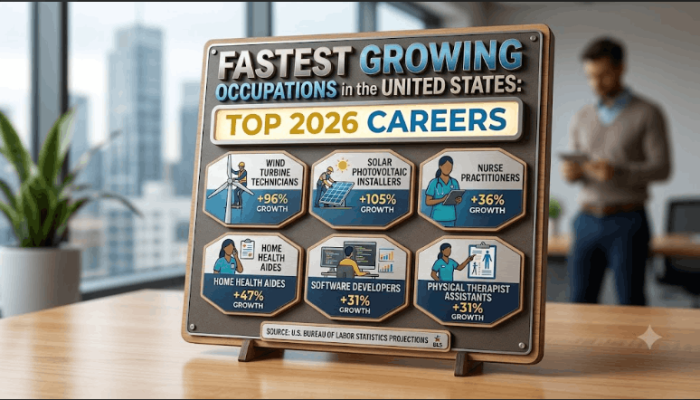
1. Solar Photovoltaic Installers
Growth Rate: 105%
Median Salary: $46,470/year
Why It’s Growing: More people and companies want clean energy. Solar panels are cheaper and more effective now. Government incentives make solar energy popular.
Key Skills: Electrical work, problem solving, physical fitness.
Tips: Learn safety rules, get certified, and stay updated with technology.
Solar installer jobs are not just about fixing panels. You must understand wiring, roof structures, and weatherproofing. There are opportunities in both residential and commercial sectors. Many states offer extra training programs or apprenticeships. A non-obvious insight: Learning about battery storage systems can make you more valuable, since more homes use solar with batteries.
2. Wind Turbine Technicians
Growth Rate: 96%
Median Salary: $52,910/year
Why It’s Growing: Wind energy is expanding, especially in rural areas. New wind farms need trained workers.
Key Skills: Mechanical repair, climbing, teamwork.
Tips: Get hands-on training, focus on safety, and work well outdoors.
Wind turbine technicians often work at heights and in remote locations. This job requires specialized tools and teamwork for repairs. Many companies offer safety classes, which are mandatory. One practical tip: Knowing how to troubleshoot electronics in turbines can open more job opportunities.
3. Home Health Aides
Growth Rate: 47%
Median Salary: $24,200/year
Why It’s Growing: The US population is getting older. Many seniors want care at home instead of hospitals.
Key Skills: Compassion, patience, basic medical knowledge.
Tips: Learn about elderly care, communication, and emergency response.
Home health aides support people with daily activities, such as bathing, dressing, and meals. They often help with medications and monitor health changes. Many agencies offer flexible hours. Non-obvious advice: Learning basic mental health support can make you stand out, as many seniors face loneliness or depression.
4. Personal Care Aides
Growth Rate: 39%
Median Salary: $24,020/year
Why It’s Growing: Similar to home health aides, but focus more on daily activities than medical care.
Key Skills: Empathy, organization, time management.
Tips: Build good relationships with clients and understand their needs.
Personal care aides often help clients with shopping, cleaning, and transportation. Good organization is key because you may work with several clients in a week. Building trust and keeping clear records of daily routines are important. A practical insight: Many employers value aides who speak more than one language, especially in multicultural communities.
5. Occupational Therapy Assistants
Growth Rate: 32%
Median Salary: $59,200/year
Why It’s Growing: More people need help with daily tasks after injuries or illnesses.
Key Skills: Therapy techniques, communication, patience.
Tips: Get certified, keep up with new therapies, and practice clear communication.
These assistants often work in hospitals, clinics, or schools. They help patients regain skills for everyday living. Continuous education is important because new therapy methods appear often. Non-obvious tip: Learning about adaptive technology (like special tools for disabled people) can boost your career.
6. Physical Therapist Assistants
Growth Rate: 31%
Median Salary: $59,440/year
Why It’s Growing: Demand for rehabilitation is high, especially among older adults.
Key Skills: Anatomy, exercise routines, teamwork.
Tips: Take practical courses, focus on patient safety, and learn new rehab methods.
Physical therapist assistants work with patients after surgery, injury, or illness. They teach exercises and track progress. Employers like assistants who show strong teamwork and attention to safety. Another insight: Many clinics prefer assistants who can handle electronic patient records and use new rehab devices.
7. Genetic Counselors
Growth Rate: 28%
Median Salary: $80,370/year
Why It’s Growing: People want to know about their genetic health risks. New medical technologies make this possible.
Key Skills: Genetics, counseling, clear communication.
Tips: Stay updated on genetic research and build empathy.
Genetic counselors help families understand health risks and make decisions about treatments. They work in hospitals, research centers, and private clinics. One practical tip: Learning about insurance and privacy laws can help you support clients better, since genetic information is sensitive.
8. Software Developers
Growth Rate: 24%
Median Salary: $110,140/year
Why It’s Growing: Apps, websites, and software are everywhere. Companies need digital solutions.
Key Skills: Coding, creativity, problem solving.
Tips: Learn new programming languages, build a portfolio, and keep up with tech trends.
Software developers work in almost every industry now, from banking to health care. Building your own apps or contributing to open-source projects can show your skills to employers. A non-obvious insight: Many companies value developers who understand user experience (UX) design, not just coding.
9. Mathematicians And Statisticians
Growth Rate: 23%
Median Salary: $93,290/year
Why It’s Growing: Big data, research, and analytics are in high demand.
Key Skills: Math, statistics, logical thinking.
Tips: Practice data analysis, learn software tools, and focus on accuracy.
These jobs often involve analyzing huge amounts of data for business, health care, and government. Knowing statistical software like R or Python is a big plus. Practical tip: Learn about data privacy and ethics, since your analysis may affect important decisions.
10. Medical Assistants
Growth Rate: 23%
Median Salary: $34,800/year
Why It’s Growing: Doctors need help with paperwork, patient care, and office tasks.
Key Skills: Medical knowledge, organization, multitasking.
Tips: Get certified, learn about electronic health records, and practice customer service.
Medical assistants often handle both clinical and administrative tasks. They schedule appointments, take vital signs, and support doctors. Many clinics now use digital records, so computer skills are important. A helpful tip: Learning basic billing and insurance codes can make you more useful to employers.
11. Information Security Analysts
Growth Rate: 28%
Median Salary: $103,590/year
Why It’s Growing: Cyber attacks are rising. Companies need experts to protect data.
Key Skills: Security systems, problem solving, attention to detail.
Tips: Get certifications, stay updated on threats, and practice ethical hacking.
Information security analysts defend networks from hackers. They work in banks, hospitals, government, and tech companies. One insight: Learning about cloud security is important, as more companies use online systems.
12. Nurse Practitioners
Growth Rate: 31%
Median Salary: $117,670/year
Why It’s Growing: Nurse practitioners can do many things doctors do. Hospitals and clinics want more of them.
Key Skills: Medical care, decision making, leadership.
Tips: Earn advanced degrees, specialize, and focus on patient communication.
Nurse practitioners can diagnose, treat, and prescribe medicine. They often lead teams in clinics. Practical tip: Choosing a specialty, like pediatrics or geriatrics, can open more job options.
13. Speech-language Pathologists
Growth Rate: 21%
Median Salary: $80,480/year
Why It’s Growing: More people need help with communication issues, especially children and seniors.
Key Skills: Language therapy, patience, listening.
Tips: Get certified, learn about new therapy tools, and practice empathy.
Speech-language pathologists work in schools, hospitals, and private clinics. They help people with speech, language, and swallowing problems. One insight: Learning about bilingual therapy can help you serve diverse communities.
14. Dental Hygienists
Growth Rate: 20%
Median Salary: $76,220/year
Why It’s Growing: People care more about dental health. Dentists need help to serve more patients.
Key Skills: Dental care, attention to detail, communication.
Tips: Learn new dental techniques and educate patients.
Dental hygienists clean teeth, check for disease, and educate patients. Many offices look for hygienists who can use digital X-ray machines and teach oral hygiene. Another tip: Keeping up with new dental products and treatments makes you more valuable.
15. Market Research Analysts
Growth Rate: 20%
Median Salary: $65,810/year
Why It’s Growing: Businesses want to understand customers and markets better.
Key Skills: Research, statistics, communication.
Tips: Use advanced analytics tools, keep up with market trends, and practice clear reporting.
Market research analysts study consumer behavior, competitor actions, and trends. They help companies make smart decisions. One practical tip: Learning about online survey tools and data visualization can make your reports clearer and more useful.
16. Computer And Information Research Scientists
Growth Rate: 19%
Median Salary: $126,830/year
Why It’s Growing: New technologies need research and innovation.
Key Skills: Computer science, research, critical thinking.
Tips: Get advanced degrees, stay updated, and collaborate with teams.
These scientists create new ways to use computers and solve big problems. They may work on artificial intelligence, robotics, or new software. Insight: Many jobs are in universities or big tech companies, so networking is important.
17. Physician Assistants
Growth Rate: 31%
Median Salary: $115,390/year
Why It’s Growing: Physician assistants help doctors, making health care more efficient.
Key Skills: Medical care, teamwork, problem solving.
Tips: Focus on communication, learn new medical techniques, and gain experience in clinics.
Physician assistants diagnose and treat patients, often in hospitals or clinics. Many work in specialties like surgery or emergency care. One tip: Building strong relationships with doctors and nurses helps you advance.
18. Diagnostic Medical Sonographers
Growth Rate: 17%
Median Salary: $75,920/year
Why It’s Growing: Imaging technology is important for diagnosis.
Key Skills: Equipment operation, anatomy, attention to detail.
Tips: Get certified, practice accuracy, and learn about new machines.
Sonographers use ultrasound to help doctors diagnose diseases. Learning about new imaging technology makes you more employable. Practical tip: Many employers value sonographers who can work flexible shifts or weekends.
19. Respiratory Therapists
Growth Rate: 21%
Median Salary: $62,810/year
Why It’s Growing: Respiratory problems are common, especially among seniors and COVID-19 patients.
Key Skills: Medical care, equipment use, patience.
Tips: Stay updated on respiratory diseases and focus on patient comfort.
Respiratory therapists treat people with breathing problems, often in hospitals. One insight: Learning about new ventilation machines and treatments can make you more valuable, especially after the pandemic.
20. Health Information Technicians
Growth Rate: 13%
Median Salary: $44,090/year
Why It’s Growing: Electronic health records are now standard. Data management is key.
Key Skills: Data entry, organization, privacy rules.
Tips: Get certified, learn new software, and practice attention to detail.
Health information technicians organize medical records and protect patient privacy. Many jobs require knowledge of federal privacy laws and computer systems. A practical tip: Learning about coding and billing systems can help you move up to supervisor roles.
Comparing Fastest Growing Occupations
Here is a comparison of growth rates and median salaries for the top 10 fastest growing jobs:
| Occupation | Growth Rate (%) | Median Salary ($) |
|---|---|---|
| Solar Photovoltaic Installers | 105 | 46,470 |
| Wind Turbine Technicians | 96 | 52,910 |
| Home Health Aides | 47 | 24,200 |
| Personal Care Aides | 39 | 24,020 |
| Occupational Therapy Assistants | 32 | 59,200 |
| Physical Therapist Assistants | 31 | 59,440 |
| Genetic Counselors | 28 | 80,370 |
| Software Developers | 24 | 110,140 |
| Mathematicians & Statisticians | 23 | 93,290 |
| Medical Assistants | 23 | 34,800 |
Notice that some jobs, like solar installers and wind technicians, show massive growth rates but lower median salaries compared to tech or health jobs. Still, these jobs offer rapid entry and good job security. On the other hand, software developers and mathematicians earn more, but need higher education and ongoing learning.
Emerging Trends Impacting Job Growth
Several trends are shaping these occupations:
- Remote Work: Many tech jobs, like software developers and data analysts, allow remote work.
- Healthcare Expansion: Aging population and pandemics increase health care needs.
- Green Energy: Jobs in solar and wind energy are growing because of climate change concerns.
- Cybersecurity: Digital threats are pushing more demand for information security analysts.
Another trend is automation. Machines and software are replacing routine tasks, so jobs that involve creativity, problem solving, or human care are growing faster. For example, robots can’t easily replace therapists or counselors.
One insight many overlook: Even jobs with lower pay, like home health aides, offer stability and personal satisfaction. Another non-obvious tip: Some “assistant” jobs can be a stepping stone to higher roles with experience and certifications.
Skills That Make You Stand Out
To succeed in these fast-growing jobs, focus on:
- Technology skills: Basic computer knowledge helps almost everywhere.
- Communication skills: Being clear and friendly is valuable in health care and tech.
- Adaptability: Learn new tools and methods quickly.
- Certifications: Many jobs require special credentials. Invest in education and training.
Practical examples: Health information technicians who learn new software can get promoted. Software developers who understand business needs can lead projects. Occupational therapy assistants who study new rehabilitation tools can help more patients.
Another insight: Soft skills, like teamwork and empathy, are more important than ever. Employers notice workers who handle stress, solve problems, and listen well.
Table: Education Requirements For Top Jobs
Here’s a quick look at the education needed for the top 10 fastest growing occupations:
| Occupation | Education Needed |
|---|---|
| Solar Photovoltaic Installers | High School Diploma + Training |
| Wind Turbine Technicians | Postsecondary Certificate |
| Home Health Aides | High School Diploma |
| Personal Care Aides | High School Diploma |
| Occupational Therapy Assistants | Associate Degree |
| Physical Therapist Assistants | Associate Degree |
| Genetic Counselors | Master’s Degree |
| Software Developers | Bachelor’s Degree |
| Mathematicians & Statisticians | Master’s Degree |
| Medical Assistants | Postsecondary Certificate |
Some jobs let you start with basic education, while others need advanced degrees. Many employers offer tuition support or training programs, so look for those benefits.

Credit: programs.com
Career Pathways And Advancement
Most fast-growing occupations offer chances to move up with experience:
- Start as an assistant or technician: Gain practical skills and learn from mentors.
- Get certifications: This boosts your resume and shows employers you’re serious.
- Continue education: Some jobs, like nurse practitioner or genetic counselor, require advanced degrees.
- Networking: Meet others in your field to learn about new opportunities.
For example, a medical assistant can become a nurse with more education. A personal care aide may move into health information technology after training.
Another pathway is specialization. For instance, respiratory therapists can focus on pediatric care or critical care, earning higher salaries and more responsibility. Software developers can become project managers or architects with experience.
A non-obvious advancement: Many health care jobs offer leadership training, which prepares you for supervisor roles. If you’re interested, ask about leadership courses or mentoring programs.
Challenges And Common Mistakes
Many people overlook challenges in fast-growing jobs:
- Physical demands: Installers and technicians often work outdoors or in tough conditions.
- Emotional stress: Health care jobs can be stressful and require patience.
- Constant learning: Tech jobs change quickly. You must keep learning new skills.
Other challenges include irregular hours, especially in health care and green energy jobs. Some occupations, like wind turbine technician, involve travel and working away from home. In tech fields, competition is high, so you must keep updating your skills.
Common mistakes:
- Ignoring certification requirements.
- Underestimating the importance of soft skills (like communication).
- Choosing a job only for salary, without considering personal interest or ability.
Some people also forget to check job location. Fast-growing jobs may be available in certain regions only. For example, wind jobs are more common in Midwest states. Research your local area before choosing a path.
How To Prepare For A Fast-growing Career
Here are steps to get ready:
- Research the occupation: Read about job duties, salaries, and growth.
- Get the right education: Choose schools or courses based on job requirements.
- Gain experience: Internships, volunteering, or entry-level jobs help.
- Build a network: Join professional groups and attend events.
- Stay flexible: Be ready to learn new skills and adapt to changes.
Real-world tip: Try job shadowing or informational interviews. Talking to people in the field gives you honest insight. Another practical step: Use online courses to build basic skills before formal training.
Table: Job Growth By Industry
Let’s see which industries have the fastest job growth:
| Industry | Job Growth (%) | Main Occupations |
|---|---|---|
| Health Care | 20-30 | Home Health Aides, Nurse Practitioners, Medical Assistants |
| Tech & IT | 18-28 | Software Developers, Information Security Analysts |
| Green Energy | 40-105 | Solar Installers, Wind Technicians |
| Business & Research | 10-20 | Market Analysts, Statisticians |
Industries like health care and green energy are growing the fastest, but tech jobs are also strong because every company needs digital solutions. Business and research jobs are steady, especially as companies want more data and insights.

Credit: wallethub.com
Real Life Example: Success In A Fast-growing Job
Consider Maria, who became a wind turbine technician after leaving her office job. She took a short training course, got certified, and now works outdoors in a fast-growing industry. Maria earns more and enjoys her work. This story shows that career shifts are possible, even in new fields.
Another example is David, who started as a medical assistant. He took extra night classes, earned a nursing degree, and now works as a nurse practitioner. David’s salary doubled, and he has more responsibility. These stories show that fast-growing jobs offer real pathways, even for those switching careers.
Finding Reliable Information And Staying Updated
Always rely on official sources for job data. The Bureau of Labor Statistics, industry groups, and government sites have up-to-date information. For regular updates, visit Bureau of Labor Statistics.
You can also follow industry newsletters, join LinkedIn groups, or attend webinars. Staying informed helps you react quickly to new trends and job openings.

Credit: www.bls.gov
Frequently Asked Questions
What Are The Best Skills For Fast-growing Jobs?
The most important skills are technology, communication, adaptability, and certifications. These skills help you stay relevant and move up in your career.
How Can I Get Started In A Green Energy Job?
Begin with short training programs or certificates. Many companies offer internships. Learn about safety and technical skills, then apply for entry-level jobs.
Are Fast-growing Jobs Stable?
Yes, but stability depends on industry trends. Health care and green energy are stable now. Tech jobs require constant learning to stay up to date.
Do I Need A College Degree For Every Fast-growing Occupation?
No. Some jobs, like solar installers or home health aides, need only a high school diploma or certificate. Others, like genetic counselor or nurse practitioner, require advanced degrees.
Where Can I Find More Information About Job Growth?
Check the Bureau of Labor Statistics and industry websites. They provide real-time updates and detailed reports.
The US job market is full of opportunities. Fastest growing occupations show where the future is headed. By focusing on skills, training, and adaptability, you can build a rewarding career in these fields. Remember, the right job for you depends on your interests, abilities, and goals.
Stay informed, keep learning, and seize new opportunities as they come.
Top Highest-Paying Jobs in the USA for 2027: No Degree Needed