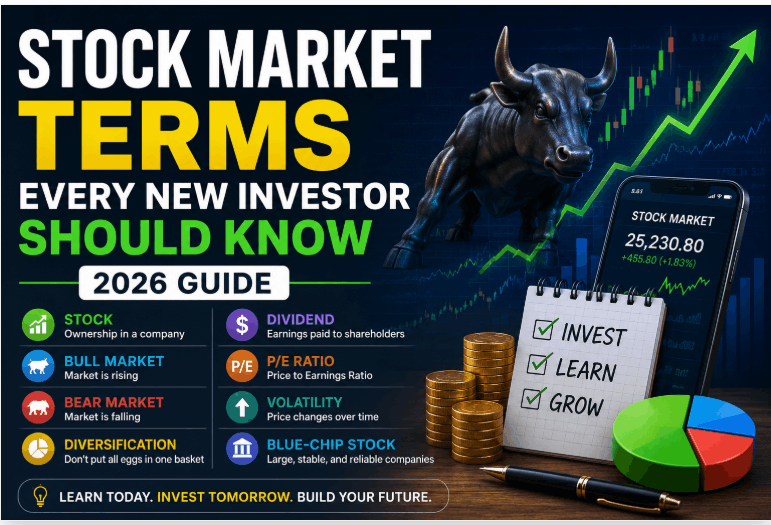
Stock Market Terms Every New Investor Should Know 2026
Stepping into the world of investing is exciting, but can feel overwhelming—especially with so many unfamiliar words and phrases flying around. If you’re a new investor, understanding the most important stock market terms isn’t just useful; it’s essential. This article is your practical guide to the language of the markets in 2026. You’ll learn what these terms mean, why they matter, and how to use them confidently when making investment decisions. Whether you want to buy your first stock or simply follow market news, knowing these key words and phrases will help you avoid mistakes and make smarter choices. Let’s break down the must-know terms for today’s investors—clearly, simply, and with up-to-date examples.
Why Understanding Stock Market Terms Matters
Many beginners jump into investing without a strong grasp of market language. This leads to confusion, poor decisions, and sometimes costly mistakes. For example, mixing up market order with limit order can mean buying a stock at a much higher price than you wanted. Or, not knowing the difference between bull market and bear market might cause you to panic-sell during a temporary drop.
The stock market is full of data and news. Headlines might mention P/E ratios, dividends, or ETFs. If you don’t know these terms, you could feel left out or even be taken advantage of. Learning the basics gives you the power to invest wisely and protects you from common traps.
Core Stock Market Terms Every Beginner Needs
Let’s start with the foundational words and phrases. These are the terms you’ll see in nearly every news report, trading app, or investment discussion.
1. Stock
A stock is a share in the ownership of a company. When you buy a stock, you own a small part of that company. If the company grows and makes money, your stock can become more valuable.
Example: If you buy one share of Apple, you own a tiny piece of Apple Inc.
2. Share
Shares are the units of stock. If a company has 1 million shares and you buy 1, you own 1/1,000,000 of that company.
3. Dividend
A dividend is money a company pays to its shareholders, usually from profits. Not all companies pay dividends, but those that do often pay them every quarter.
Example: In 2026, Microsoft paid a quarterly dividend of $0.68 per share.
4. Portfolio
Your portfolio is your collection of investments—stocks, bonds, ETFs, etc. A balanced portfolio often helps reduce risk.
5. Bull Market
A bull market is a period when stock prices are rising, and investors are optimistic. It’s a sign of a healthy, growing economy.
6. Bear Market
A bear market is the opposite: prices are falling, and investors feel pessimistic. A drop of 20% or more from recent highs is often called a bear market.
7. Index
An index measures the performance of a group of stocks. Popular examples are the S&P 500, Dow Jones Industrial Average, and Nasdaq Composite.
Example: If the S&P 500 is up 2%, it means the largest 500 US companies (by market cap) are, on average, doing well.
8. Market Capitalization (market Cap)
Market cap is the total value of a company’s shares. It’s calculated by multiplying the share price by the number of shares.
Example: If Tesla has 1 billion shares and each costs $700, its market cap is $700 billion.
9. Volume
Volume shows how many shares are bought and sold in a certain period. High volume often means more investor interest.
10. Volatility
Volatility is how much a stock’s price moves up and down. High volatility means bigger price swings, which can mean more risk—and more opportunity.
Knowing how to buy and sell is just as important as knowing what to buy. Here’s what you need to understand about the different ways you can trade.
1. Market Order
A market order tells your broker to buy or sell immediately at the best available price. It’s fast but doesn’t guarantee the price.
Example: If you place a market order to buy Apple, you’ll get the current price, whatever it is.
2. Limit Order
A limit order sets a specific price. Your order only goes through if the stock hits that price.
Example: You want to buy Tesla at $650, but it’s trading at $700. With a limit order, your order only fills if Tesla drops to $650.
3. Stop Order (stop-loss Order)
A stop order becomes a market order when a stock hits a certain price. It’s often used to limit losses.
Example: If you own a stock at $100 and set a stop order at $90, your shares will sell if the price falls to $90.
4. Bid And Ask
The bid is the highest price someone will pay for a stock. The ask is the lowest price someone will sell for.
Tip: The difference is called the spread. A narrow spread means high liquidity.
Order Type
Execution Speed
Price Guarantee
Best For
Market Order
Fastest
No
Quick trades
Limit Order
Depends on price
Yes
Price control
Stop Order
Triggered at stop price
Partial
Managing risk
Investment Vehicles And Products
Stocks aren’t the only thing you can buy. Here are common investment types, each with their own terms.
1. Etf (exchange-traded Fund)
An ETF is a basket of stocks (or other assets) you can buy and sell like a single stock. ETFs are popular because they offer instant diversification and usually have low fees.
Example: The SPDR S&P 500 ETF (SPY) tracks the S&P 500 index.
2. Mutual Fund
A mutual fund pools money from many investors to buy a group of stocks, bonds, or other assets. They’re managed by professionals, but may have higher fees.
3. Bond
A bond is a loan you give to a company or government. They pay you interest, and return your money later. Bonds are generally less risky than stocks.
4. Ipo (initial Public Offering)
An IPO is when a company sells shares to the public for the first time. Buying IPO shares can be risky—prices can jump or fall quickly.
5. Blue Chip Stock
Blue chip stocks are shares in large, well-known companies with strong track records. Examples include Apple, Microsoft, and Johnson & Johnson.
6. Growth Stock
A growth stock belongs to a company expected to grow faster than average. These stocks might not pay dividends, as profits are reinvested.
7. Value Stock
A value stock is seen as undervalued compared to its fundamentals. Investors hope the price will rise as the market recognizes its worth.
8. Penny Stock
Penny stocks are very cheap stocks, often trading for under $5. They’re risky and can be hard to sell.
9. Reit (real Estate Investment Trust)
A REIT is a company that owns income-producing real estate. REITs let you invest in property without buying buildings yourself.
Stock Market Terms Every New Investor Should Know 2026 Guide 14
Credit: insights.playsipindia.com
Financial Ratios And Analysis Terms
Investors use financial ratios to decide if a stock is a good buy or not. Here are the most useful ones:
1. P/e Ratio (price-to-earnings)
The P/E ratio shows how much investors are willing to pay for $1 of earnings. It’s calculated by dividing the stock price by earnings per share.
Example: If Apple’s stock is $150 and earnings per share are $5, the P/E ratio is 30.
2. Eps (earnings Per Share)
EPS is the company’s profit divided by the number of shares. Higher EPS usually means a more profitable company.
3. Dividend Yield
Dividend yield is the annual dividend divided by the stock price, shown as a percentage. It helps you compare income from different stocks.
Example: If a stock pays $2 a year and costs $40, the yield is 5%.
4. Market Cap Categories
Companies are grouped by size:
Large-cap: Over $10 billion
Mid-cap: $2–10 billion
Small-cap: $300 million–$2 billion
Large-cap stocks are usually less risky.
5. Beta
Beta measures how much a stock moves compared to the market. Beta of 1 means it moves with the market. Above 1 = more volatile, below 1 = less volatile.
6. Roe (return On Equity)
ROE shows how well a company uses shareholder money to make profits. Higher ROE is better.
7. Debt-to-equity Ratio
This ratio shows how much debt a company has compared to its equity. Too much debt can be risky.
8. Book Value
Book value is what a company would be worth if it closed and sold everything. If a stock trades below book value, it could be a bargain—or a warning sign.
9. Cash Flow
Cash flow is the money coming in and out of a company. Healthy cash flow is a sign of a strong business.
Ratio
Formula
What It Shows
Good For
P/E Ratio
Price/Earnings
Stock value vs. profit
Comparing stocks
Dividend Yield
Dividend/Price
Income from stock
Income investing
Beta
Price movement vs. market
Risk level
Risk assessment
Market Trends And Sentiment
Understanding how investors feel and how markets move is key to smart investing.
1. Correction
A correction is a drop of 10% or more from a recent high. Corrections are normal and can be healthy for markets.
2. Crash
A crash is a very fast, sharp drop—often over 20% in days or weeks. The COVID-19 crash in March 2020 is a recent example.
3. Rally
A rally is a quick, strong rise in prices, often after a drop.
4. All-time High/low
When a stock or index hits its highest or lowest price ever.
5. Resistance And Support
Resistance is a price level where a stock struggles to rise above. Support is where it tends to stop falling.
6. Market Sentiment
Market sentiment is the overall mood of investors—optimistic (bullish) or pessimistic (bearish).
7. Fomo And Fud
FOMO (Fear Of Missing Out) can cause investors to jump in at the top. FUD (Fear, Uncertainty, Doubt) can cause panic selling.
8. Short Selling
Short selling is betting that a stock’s price will go down. You borrow shares, sell them, and hope to buy them back cheaper.
Warning: Losses can be unlimited if the price rises.
9. Margin
Margin means borrowing money to buy stocks. It can boost gains, but also losses.
Regulatory And Market Structure Terms
Markets have rules and organizations to keep things fair. Here’s what you’ll see as you learn more:
1. Sec (securities And Exchange Commission)
The SEC is the US government agency that regulates the stock market. It protects investors and keeps markets honest.
2. Finra
FINRA is a private group that oversees brokers and trading firms. They make sure rules are followed.
3. Exchange
An exchange is where stocks are bought and sold. The main US exchanges are the NYSE (New York Stock Exchange) and Nasdaq.
4. Ticker Symbol
A ticker symbol is a short code for a stock. Example: AAPL for Apple.
5. Circuit Breaker
A circuit breaker is a rule that halts trading if prices drop too quickly. It helps prevent panic.
6. Insider Trading
Insider trading is buying or selling stocks using secret, non-public information. It’s illegal and can lead to jail time.
7. Order Book
The order book lists all buy and sell orders for a stock. It shows supply and demand in real time.
Digital And Technology Terms In Modern Trading
The stock market in 2026 is more digital than ever. Here are terms you need to know as technology transforms investing.
1. Algorithmic Trading
Algorithmic trading uses computer programs to place trades automatically, often in milliseconds. It’s common in today’s markets.
2. Robo-advisor
A robo-advisor is an automated service that builds and manages your portfolio using algorithms. Fees are usually lower than with human advisors.
3. High-frequency Trading (hft)
High-frequency trading is when computers make thousands of trades per second. It can add liquidity but sometimes causes sharp price moves.
4. Blockchain
Blockchain is a technology that records transactions securely and publicly. It’s the backbone of cryptocurrencies, but is starting to be used in traditional finance too.
5. Tokenization
Tokenization turns real assets (like stocks or real estate) into digital tokens you can buy and sell online. This is an area to watch for the future.
6. Decentralized Finance (defi)
DeFi uses blockchain to create financial services without banks or brokers. It’s still new, but growing fast.
7. Api (application Programming Interface)
An API lets different software “talk” to each other. Many broker apps use APIs to connect your account with other tools.
Stock Market Terms Every New Investor Should Know 2026 Guide 15
Credit: chasesecurities.com
Practical Insights For New Investors
Understanding the terms above is a strong first step. But successful investing also means knowing how to use them. Here are two practical insights many beginners miss:
Context is everything: The same term can mean different things in different situations. For example, a “bull market” in tech stocks doesn’t mean all stocks are rising. Always look at the bigger picture and specific industry.
Not all data is created equal: Financial ratios like P/E or dividend yield can be misleading if you don’t check the details. For example, a very high dividend yield could mean the stock price fell because the company is in trouble.
Pro tip: Use trusted sources for financial data and company reports. Avoid trading based only on social media tips or hype.
Common Investor Mistakes With Terms
New investors often misuse or misunderstand key market terms. Here are a few common errors—and how to avoid them:
Confusing price with value: A low stock price doesn’t mean it’s “cheap.” Check market cap, earnings, and other fundamentals.
Ignoring fees: Some ETFs and mutual funds have high fees that eat into returns. Always check the expense ratio.
Chasing trends: FOMO can lead to buying at the top. Take your time, research, and don’t rush into “hot” stocks.
Misreading volatility: High volatility can bring opportunity, but also risk. Make sure your investments fit your goals and risk tolerance.
Real-world Example: How Terms Work Together
Imagine you’re interested in buying your first stock—let’s say, Tesla. You check the ticker symbol (TSLA), see the current market price, and notice high volume today. You read that it’s a large-cap growth stock. The P/E ratio is higher than the average S&P 500 stock, which means investors expect fast growth. Tesla doesn’t pay a dividend, so you’re counting on price appreciation.
You decide not to use a market order (since prices are moving quickly), and instead set a limit order at a price you’re comfortable with. You check the bid/ask spread to make sure there’s enough liquidity. After buying, you add Tesla to your portfolio and track its performance, checking for news that might affect its volatility or overall market sentiment.
This step-by-step process shows how knowing the right terms helps you make smarter choices, avoid errors, and feel more confident as an investor.
Key Differences: Stocks, Etfs, And Mutual Funds
To help you decide what to invest in, here’s a side-by-side look at three popular investment types.
Investment Type
Ownership
Trading
Fees
Diversification
Stock
Single company
Any time during market hours
Low (per trade)
No
ETF
Basket of assets
Any time during market hours
Low (expense ratio)
Yes
Mutual Fund
Basket of assets
Once per day (after market close)
Varies, can be high
Yes
Staying Current: Evolving Terms In 2026
The language of investing keeps changing, especially with new technology and market trends. Here are a few terms that have become more important in 2026:
ESG Investing: ESG stands for Environmental, Social, and Governance. Investors now look at how companies treat the environment, people, and their own leadership. ESG funds are growing fast.
SPAC (Special Purpose Acquisition Company): A shell company that raises money to buy another company. SPACs became popular in the 2020s, but are more regulated now.
Fractional Shares: Many brokers now let you buy a fraction of a share, making it easier to invest with small amounts of money.
Thematic ETFs: These funds invest in a specific theme, like clean energy, AI, or cybersecurity.
The best investors keep learning. Follow trusted financial news, official reports, and reliable sources such as Investopedia to stay up-to-date.
Frequently Asked Questions
What Is The Safest Way For Beginners To Invest In The Stock Market?
For most beginners, ETFs and index funds offer a safe start. They provide instant diversification and lower risk than buying individual stocks. Always research before investing and avoid putting all your money into one company.
How Much Money Do I Need To Start Investing?
Today, you can start with as little as $1 thanks to fractional shares. Many brokerages have no minimum deposit. However, having at least $100–$500 lets you build a more balanced portfolio.
What Is The Difference Between A Stock And An Etf?
A stock is ownership in one company. An ETF is a basket of many stocks, bonds, or other assets, traded like a single stock. ETFs offer more diversification and often lower risk.
Why Do Stock Prices Go Up And Down?
Stock prices move because of supply and demand, company news, earnings reports, economic data, and investor sentiment. Sometimes, prices move for emotional reasons—like fear or excitement—not just facts.
How Can I Keep Learning About Investing?
Follow reliable news sites, read company reports, and use educational tools from your brokerage. Consider podcasts, books, or even online courses. Staying curious and asking questions is key to long-term success.
Investing in the stock market is a journey, not a race. By learning the most important stock market terms, you build a strong foundation for your future as an investor. Stay patient, keep learning, and remember: knowledge is your best investment tool.
How Inflation Affects the Stock Market in 2026: What to Expect Read More