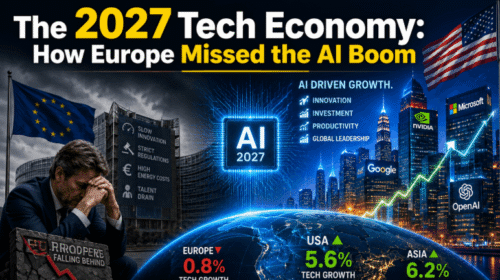










The past decade has seen artificial intelligence (AI) rise from a niche technology to a global investment craze. Startups and tech giants alike are racing to build smarter systems, while investors pour billions into anything labeled “AI.” Headlines scream about new breakthroughs, soaring company valuations, and even trillion-dollar market caps. But as the hype grows, so do questions: Is the AI boom truly sustainable, or are we headed for a painful correction by 2026? If you’re investing in AI—or thinking about it—you need to understand the forces at play, the risks building up, and what history can teach us about technology-driven bubbles. Let’s break down what’s really happening and how you can prepare for what comes next.
The Scale Of The Ai Investment Boom
AI is everywhere—self-driving cars, chatbots, medical diagnosis tools, and even art. In 2026 alone, global investment in AI startups topped $115 billion, according to CB Insights. Big Tech isn’t slowing down: Microsoft invested $10 billion in OpenAI, Google’s parent company Alphabet is doubling down on AI research, and Amazon is integrating AI into everything from Alexa to supply chains.
Why such excitement? Many believe AI will reshape the world economy, creating trillions of dollars in new value. Goldman Sachs estimated that generative AI could raise global GDP by 7% (about $7 trillion) over the next decade. Investors see AI as the next internet or electricity—a foundational technology.
But with so much money flowing in, not all investments are equal. Some companies have real, scalable products; others are chasing hype. The last time this happened—during the dot-com bubble—many investors got burned when reality caught up to overblown expectations.
What’s Driving The Frenzy?
Several factors are fueling the current AI investment surge:
1. Breakthroughs In Generative Ai
Tools like ChatGPT and DALL-E have amazed both the public and investors. These advances make AI feel tangible and “real” for the first time, not just science fiction.
2. Fomo (fear Of Missing Out)
No one wants to miss the “next big thing. ” Venture capitalists, hedge funds, and even regular investors are piling in, afraid they’ll miss out on the next Google or Amazon.
3. Corporate Adoption
Major companies are racing to integrate AI into their businesses. This creates a sense that AI is not just hype—it’s becoming central to how business is done.
4. Media Hype
Every day, headlines announce new AI breakthroughs, billion-dollar deals, and unicorn startups. This keeps excitement—and investment—at a fever pitch.
5. Low Interest Rates (until Recently)
For years, money was cheap. Investors sought high-growth opportunities, and AI promised just that. Now, as rates rise, the risk profile is changing.
Historical Bubbles: Lessons From The Past
The dot-com crash of 2000 is the closest comparison to today’s AI frenzy. Back then, investors believed the internet would change everything (they were right), but they overestimated how quickly this would happen and underestimated the risks.
A few examples:
- Pets.com went public in 2000, soared to a $300 million valuation, then collapsed within a year.
- Cisco was a real business, but its stock lost 86% of its value during the crash.
- Many companies with “.com” in their name attracted huge investments without any real business model.
Similarities to today’s AI boom:
- Huge amounts of money chasing a new technology
- Inflated valuations
- Startups raising money on promises, not profits
- A few real winners, but many losers
But there are differences, too. The internet did change the world, just not as fast as people hoped. Likewise, AI will be transformative, but not every AI company will win.
Are We In An Ai Bubble?
Many experts are divided. Some, like Sam Altman (CEO of OpenAI), warn that the current pace of AI investment is unsustainable. Others argue this is just the start.
Signs Of A Bubble
- Sky-high valuations: Some AI startups have raised money at valuations of $1 billion or more, even before showing profits or, in some cases, revenue.
- Copycat startups: Many new companies are simply repackaging existing AI tools with little innovation.
- Hype over substance: Some founders promise revolutionary technology that doesn’t exist yet or is years from practical use.
Contradictory Signals
- Revenue growth: Some AI firms are showing real, rapid revenue growth.
- Corporate spending: Major companies are actually spending billions to integrate AI, not just talking about it.
- Long-term trends: AI is deeply embedded in data, cloud, and enterprise software, unlike many dot-com fads.
What Makes The Ai Market Different?
While history offers warnings, today’s AI market also has unique strengths:
- Real Adoption: Companies like Nvidia, which supplies AI chips, are reporting record sales and profits. Cloud giants (AWS, Google Cloud, Azure) are seeing growth from AI demand.
- Widespread Use Cases: AI is not just for tech companies—banks, hospitals, and factories are using AI to solve real problems, cut costs, and boost productivity.
- Advances in Hardware and Data: The tools needed to build and run AI are improving fast, making it easier to scale real products.
- Government Support: Many countries are backing AI research, funding innovation, and setting national strategies.
But even with these strengths, not every AI investment will succeed. The market is getting crowded, and competition is fierce.
Risks Investors Face In The Coming Years
As 2026 approaches, here’s what investors should watch out for:
1. Valuation Risk
Many AI companies are valued based on future potential, not current earnings. If growth slows or costs rise, these sky-high values can drop quickly.
2. Regulation And Legal Uncertainty
Governments are starting to regulate AI, especially around data privacy, safety, and ethical use. New rules could raise costs or limit some business models.
3. Technical Hurdles
Some AI promises are harder to deliver than people think. For example, self-driving cars are still years from safe, everyday use.
4. Competition
The AI field is crowded. Open-source projects (like Meta’s Llama) and global rivals (China, Europe) are moving fast. Many startups may be outcompeted or acquired.
5. Market Saturation
As every company tries to add “AI” to their products, some markets may become over-supplied, lowering profits.
6. Hardware Bottlenecks
AI relies on powerful chips (like Nvidia’s GPUs). Supply chain issues or rising chip costs can slow growth.
7. Hype Cycle And Sentiment Shifts
If public excitement fades or a few high-profile failures happen, investor sentiment can turn quickly, leading to a correction.

Credit: www.cioinvestmentclub.com
Data Snapshot: Ai Funding And Valuations (2026–2026)
To understand the boom, let’s look at some key numbers:
| Year | Total AI Funding (USD) | Number of AI Unicorns | Median Valuation |
|---|---|---|---|
| 2026 | $68 billion | 85 | $500 million |
| 2026 | $89 billion | 119 | $700 million |
| 2026 | $115 billion | 173 | $1.2 billion |
| 2026 (est.) | $130+ billion | 200+ | $1.5 billion |
*Source: CB Insights, Crunchbase (2026)*
Insight: Funding and valuations are rising fast, but the number of profitable, sustainable businesses is not growing as quickly. Many unicorns are still not making money.
Sectors Most Exposed To The Ai Bubble
Not every part of the AI market is equally risky. Here’s where the risks and opportunities are concentrated:
Most At Risk
- Early-stage AI startups with no clear path to profit
- “AI for everything” software tools that don’t solve a unique problem
- Consumer-facing AI apps with no user loyalty or defensible technology
- Companies that rely on open-source models with little differentiation
Stronger Positions
- AI infrastructure providers (like Nvidia, AMD, and cloud platforms)
- Enterprise AI platforms with real customers and revenue
- AI tools embedded in core business operations (healthcare, logistics, finance)
- Firms with proprietary data and technology that are hard to copy

Credit: www.privatebank.bankofamerica.com
How To Tell Hype From Real Value
Investors need ways to separate hype from sustainable value. Here are practical signs to look for:
- Revenue Growth: Is the company actually selling AI products or services? What is the year-over-year growth?
- Customer Adoption: Are well-known companies using the product, and do they renew contracts?
- Cost Structure: Does the company have a path to profitability, or do costs rise faster than sales?
- Unique Technology or Data: Does the company own something special—algorithms, data, patents—that gives it an edge?
- Execution Track Record: Has the team delivered before, or are they just telling a good story?
- Market Position: Is the company a leader in a growing field, or just one of many?
Non-obvious insight: Many startups look impressive but rely heavily on third-party AI models (like OpenAI’s GPT) and have little control over costs or performance. If those models change pricing or terms, the startup’s business can collapse overnight.
The Case For A 2026 Ai Correction
Why do many analysts point to 2026 as a possible “pop” year for the AI boom?
- Product Cycles: Many current AI projects are set to launch or reach maturity in 2026–2026. If results disappoint, investors may pull back.
- Regulatory Timelines: The EU’s AI Act and US rules may hit full force by 2026, adding costs and uncertainty.
- Economic Shifts: If interest rates stay high or a recession hits, riskier investments (like unprofitable AI startups) will suffer most.
- Market Saturation: Too many similar products could mean falling prices and profits.
What Could Prevent A Crash?
While risks are real, a total “pop” is not guaranteed. Several trends could keep the AI boom going:
- Continued breakthroughs: Major leaps in AI (like “artificial general intelligence”) could create new markets and demand.
- Mass-market adoption: If AI becomes as essential as smartphones or PCs, growth could stay strong.
- Profitability: If more AI companies start making money, valuations become more justified.
- Mergers and acquisitions: Big tech could buy struggling AI startups, preventing mass failures.
How Investors Can Protect Themselves
Whether a correction comes in 2026 or not, smart investors can take steps now:
1. Diversify Holdings
Don’t put all your money in AI. Balance tech bets with other sectors.
2. Focus On Fundamentals
Look for companies with real revenue, profits, and customers—not just hype.
3. Understand The Tech
If you can’t explain what the company actually does, be cautious. Many AI investments are wrapped in jargon.
4. Watch For Dilution
Many AI startups raise new funding rounds at high valuations, diluting early investors.
5. Stay Informed On Regulation
New rules can change the game fast. Keep up with global developments.
6. Have An Exit Plan
Decide in advance when you’ll sell—if growth slows, if losses mount, or if the sector overheats.
7. Don’t Chase Fomo
If you feel pressured to invest because “everyone else is doing it,” take a step back.
Non-obvious insight: Some of the biggest winners of past tech bubbles were companies that survived the crash, not those who soared during the hype. Amazon lost 90% of its value after the dot-com bubble, but then became one of the world’s most valuable companies.

Credit: cacm.acm.org
Real-world Example: Openai Vs. Nvidia Vs. Generic Ai Startups
Let’s compare three types of AI investments using recent data:
| Company Type | 2026 Valuation | Revenue Growth (YoY) | Profitability | Moat (Competitive Edge) |
|---|---|---|---|---|
| OpenAI (Foundation Model) | $80 billion | 300%+ | No | First-mover, advanced models |
| Nvidia (AI Hardware) | $2.2 trillion | 250%+ | Yes | Chip dominance, ecosystem |
| Generic AI Startup | $1 billion | Unknown | No | Minimal, relies on others’ models |
The biggest, most defensible AI firms are generating real sales and have unique technology. Many smaller startups, despite huge valuations, lack a clear path to profit or market leadership.
How Ai Regulation Could Reshape The Market
In 2026 and 2026, the EU and US took big steps toward regulating AI. The EU’s AI Act is expected to take effect by 2026, setting strict requirements for transparency, safety, and ethics. The US is considering similar measures.
Potential Impacts:
- Increased compliance costs: Startups may struggle to keep up with new rules, giving an edge to large firms.
- Slower rollouts: Some AI products may be delayed or limited in key markets.
- Greater trust: Clear rules could make businesses and consumers more willing to adopt AI.
- Reduced risk: Responsible AI practices could prevent scandals and failures.
Regulation is a double-edged sword. It can reduce wild speculation but also raise the bar for entry.
The Human Side: Ai Hype Vs. Real Impact
Behind the numbers, it’s easy to forget the human impact of the AI boom. Some jobs are being automated, while new kinds of work are being created. People worry about bias, privacy, and control over powerful AI systems.
Investors should ask: Is the company solving real problems for people, or just building tech for tech’s sake? The businesses that survive long-term will be those that create true value—helping people work, learn, stay healthy, or live better.
What The Smartest Investors Are Doing
Large investment funds like BlackRock and Sequoia Capital are not blindly buying every AI stock. Instead, they are:
- Partnering with industry experts to assess real technology
- Favoring companies with proven products and revenue
- Watching for overheated sectors and avoiding the most crowded trades
- Preparing for both growth and correction, with flexible strategies
Individual investors can learn from this approach: be skeptical of hype, do your homework, and focus on sustainable businesses.
Data Table: Top 5 Ai Public Companies By Market Cap (2026)
| Company | Market Cap | Main AI Focus | 2026–24 Stock Gain |
|---|---|---|---|
| Nvidia | $2.2 trillion | AI Chips/Hardware | +250% |
| Microsoft | $3.1 trillion | Cloud AI, OpenAI Partner | +70% |
| Alphabet (Google) | $2.0 trillion | Search, Cloud AI | +55% |
| Amazon | $1.9 trillion | Cloud AI, Commerce | +60% |
| Meta (Facebook) | $1.3 trillion | AI Research, Social AI | +85% |
*Source: Yahoo Finance (May 2026)*
The Bottom Line For Ai Investors
The AI investment boom is not just hype—real breakthroughs are happening, and some companies are earning big profits. But the risk of a correction or even a “bubble pop” by 2026 is real, especially for overvalued or copycat firms. Smart investors will look past headlines, focus on fundamentals, and prepare for both ups and downs.
If you’re in the market today, ask tough questions: Does this company have a real business? Can it survive if hype fades? Is it protected from new rules or competition? The answers will guide you through the turbulence ahead.
As with all technology revolutions, the winners will be those who combine vision with discipline. AI will change the world—but not every AI investment will change your life for the better.
For more on current AI regulations and market analysis, see this Wall Street Journal AI coverage.
Frequently Asked Questions
What Are The Main Signs Of An Ai Investment Bubble?
Key signs include sky-high valuations without profits, many startups with similar products, heavy media hype, and investors chasing the trend without understanding the underlying technology.
How Can I Tell If An Ai Company Is A Safe Investment?
Look for real revenue, strong customer adoption, unique technology or data, and a clear plan for profit. Avoid companies that rely on hype or lack clear differentiation.
Will Ai Regulation Hurt Or Help The Market?
Regulation can raise costs and slow some projects, but it can also build trust and prevent scandals. Well-run companies may benefit, while weaker ones could struggle.
Is 2026 A Guaranteed “pop” Year For The Ai Bubble?
No one can predict the exact timing, but 2026 is seen as a risk point because of new regulations, product launches, and possible economic changes. Prepare for volatility, not certainty.
What Should I Do If I’m Already Invested In Ai?
Stay informed, diversify your holdings, focus on companies with real value, and have a clear exit plan if the market turns. Don’t be driven by FOMO—make decisions based on evidence, not emotion.
Top 3 Predictions for AI Stocks in 2H 2026: Buy the Dip Now?