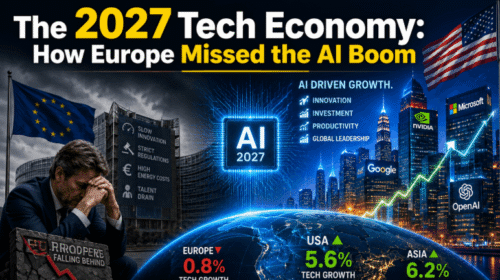










Tech Economy How Europe Missed the AI Boom
The global economy is rapidly transforming through artificial intelligence (AI), but not every region is keeping pace. In 2027, the United States and China continue to lead AI innovation, investment, and economic growth, while Europe struggles to remain competitive. This article explores why Europe missed the AI boom, the key factors behind the widening technology gap, and what it means for the future of the global tech economy.
How Ai Is Reshaping The Global Tech Economy
AI is not just a buzzword. It’s a force driving major changes in business, healthcare, manufacturing, and education. In 2026, AI will power:
-
- Automation: Machines and software replacing routine tasks.
-
- Personalization: Tailored services, marketing, and products.
-
- Predictive analytics: Better decision-making for businesses.
-
- Smart infrastructure: Cities and factories running on AI-powered systems.
These advances reach deeper than most people realize. Automation is not just about robots in factories—it now includes software bots that handle customer service, accounting, and logistics. In healthcare, AI-powered diagnostics help doctors detect diseases earlier, often improving patient outcomes.
Personalized marketing uses AI to analyze customer behavior, allowing businesses to offer products that fit individual needs. Predictive analytics is changing how companies plan for the future, helping them avoid costly mistakes and seize opportunities faster.
According to Statista, the global AI market is expected to reach $500 billion by 2026. The US and China will contribute more than 70% of this value. Europe’s share is projected to be less than 15%.
Real-world Impact
-
- Job creation: AI is creating new roles like AI engineer, data scientist, and machine learning specialist. These jobs pay more than average and require advanced skills, attracting young talent and experienced workers alike.
-
- Productivity boost: Companies using AI report up to 40% higher efficiency. This translates to faster production, fewer errors, and improved customer satisfaction. For example, in manufacturing, AI helps predict maintenance needs, reducing downtime and saving money.
-
- Economic growth: AI-driven businesses are growing twice as fast as traditional firms. Startups with AI solutions often get noticed quickly, leading to faster scaling and more investment.
But these benefits are not evenly distributed. The US and China are leading, while Europe is falling behind. This divide is growing every year, affecting both economic opportunity and global influence. Some European firms struggle to compete internationally, even when their technology is strong, because they lack the scale and support seen in the US and China.
AI also brings changes to daily life. In education, AI tutors help students learn faster, adapting lessons to individual needs. In transportation, AI manages traffic flow and predicts delays, making cities safer and more efficient. People in the US and China experience these advances more often because companies there are able to deploy new technology quickly.
Why The Us And China Lead The Ai Boom
When you look at the numbers, the US and China dominate the AI industry. Here’s why:
Investment And Funding
The US and China attract the most AI investment. In 2026, the US saw over $60 billion in AI funding, China followed with about $35 billion. Europe managed just $8 billion.
-
- Venture capital: US and Chinese startups receive bigger, faster funding. Investors in these regions are willing to bet on risky, innovative ideas, which encourages rapid development and experimentation. European startups often spend months seeking funding, while their US or Chinese counterparts can secure millions in weeks.
-
- Government support: Both countries have strong national AI strategies. The US government offers grants and incentives; China’s government invests directly in AI infrastructure and education.
Many investors in the US and China are also willing to fund projects that may not succeed, knowing that failures often lead to breakthroughs later. This culture of risk-taking is less common in Europe, where investors prefer proven business models.
Talent And Innovation
-
- Top universities: Schools like MIT, Stanford, and Tsinghua produce world-class AI talent. These universities attract students from around the world, many of whom stay in the US or China after graduation.
-
- Patent filings: The US and China file more than 80% of all AI patents worldwide. This shows not only innovation, but also a commitment to protecting and scaling new ideas.
-
- Research papers: Most cited AI research comes from these two countries. Academic institutions in the US and China work closely with industry, leading to faster commercialization of new discoveries.
Beyond numbers, talent in the US and China often has access to resources that help them turn ideas into real products—labs, funding, and partnerships. European researchers sometimes face barriers when moving from academia to business.
Market Scale
-
- Large populations: More data means better AI models. Data is the fuel for AI, and the US and China have access to vast pools—both in quantity and diversity.
-
- Tech giants: Companies like Google, Amazon, Baidu, Tencent drive innovation. These firms have the money and reach to test new technology at scale, pushing AI into everyday life.
The US and China also have unified markets, allowing companies to launch products nationwide without changing their approach for different regions. Europe’s fragmented markets make scaling much harder.
Regulatory Flexibility
-
- Faster approvals: US and China adapt regulations quickly for new tech. When a new AI product is ready, it can often reach users within weeks. In Europe, approval can take months or even years.
-
- Risk tolerance: Entrepreneurs are encouraged to take risks. Mistakes are seen as learning experiences, not failures.
This flexibility extends to how companies handle data. The US and China have fewer restrictions, allowing faster collection and analysis.
Let’s compare the main factors in a table:
| Factor | US | China | Europe |
|---|---|---|---|
| AI Investment (2026) | $60B | $35B | $8B |
| AI Patents Filed (2026) | 35,000 | 32,000 | 6,500 |
| Top AI Universities | MIT, Stanford | Tsinghua, Peking | Oxford, ETH Zurich |
| Market Share (2026, est.) | 38% | 33% | 14% |
The numbers show a clear pattern: the US and China have larger markets, more funding, and stronger talent pipelines. Europe’s figures, while respectable, lag behind.
What’s Holding Europe Back?
Europe’s tech economy is strong in many ways, but it’s missing the AI boom. The reasons are complex:
Strict Regulations
Europe’s GDPR and strict privacy laws limit data collection. AI needs large datasets to learn and improve. These laws, while protecting citizens, make it harder for companies to build powerful AI tools.
-
- Data access: Companies struggle to get enough data. For example, a hospital in Germany may not be able to share patient data with an AI startup in France, even if it could help improve healthcare.
-
- Slow approvals: New AI products face long review processes. Startups must prove compliance with privacy laws before launching, which slows innovation.
The intention behind strict regulations is good—protecting people from misuse—but the result is that European companies often cannot compete with US or Chinese firms who can access more data and move faster.
Fragmented Markets
Unlike the US and China, Europe is a patchwork of countries, languages, and regulations.
-
- Different rules: Each country has its own tech laws. A company launching an AI tool in Spain must adjust for regulations in Italy, Germany, and France.
-
- Small markets: Startups must adapt for each nation. This increases costs and slows expansion.
For example, a company building an AI-powered translation service must support multiple languages and comply with unique data laws in each country. This makes scaling much harder compared to a US or Chinese company.
Less Risk Capital
European investors are more cautious. They fund fewer risky projects.
-
- Smaller investments: Less money for bold AI ideas. Startups may need to look outside Europe for funding.
-
- Fewer unicorns: Europe has just 10% of global tech unicorns. Unicorns are startups valued at over $1 billion, and they often drive innovation.
This cautious approach means fewer European startups become global leaders. Investors prefer companies with steady returns, not those taking big risks.
Talent Drain
Many top European tech graduates move to the US or China for better pay and opportunities.
-
- Brain drain: Europe loses skilled workers. Some estimates suggest that nearly 30% of top AI graduates in Europe leave within two years.
-
- Fewer incentives: Lower salaries and slower career growth. Talented workers can earn more and advance faster in the US or China.
European companies also struggle to attract talent from abroad, making it harder to build diverse teams.
Conservative Business Culture
European businesses prefer steady growth over fast innovation.
-
- Less experimentation: Companies stick to proven methods. This limits new ideas.
-
- Slower adoption: AI tools take longer to reach the market. Even when a company has a good product, it may wait to launch until it’s sure of success.
While this approach reduces risk, it also limits opportunity. US and Chinese firms often launch products early, learning from feedback and improving quickly.
Here’s a comparison of regulatory climate:
| Region | Data Privacy Laws | Startup Ecosystem | Risk Tolerance |
|---|---|---|---|
| US | Flexible | Strong | High |
| China | Moderate | Very Strong | High |
| Europe | Strict | Fragmented | Low |
Europe’s strict laws and fragmented markets create barriers that don’t exist in the US and China. This slows AI development, limits scale, and makes attracting investment harder.
Real Examples: Us & China’s Ai Surge
Us Success Story: Openai
OpenAI, the creator of ChatGPT, is based in San Francisco. It raised over $10 billion and collaborates with Microsoft. Its technology is used in businesses, schools, and hospitals.
-
- Rapid growth: OpenAI’s tools reached millions in months. ChatGPT became a household name, showing how quickly AI can spread when supported by strong funding and partnerships.
-
- Innovation hub: Attracts top researchers and engineers. OpenAI works with experts from around the world, focusing on both technical progress and ethical AI.
OpenAI also shares its research and tools widely, encouraging other companies to build on its work. This open approach helps the US maintain its lead in AI innovation.
China’s Ai Giant: Sensetime
SenseTime is a leading AI company in China, focusing on facial recognition and smart city solutions. Backed by Alibaba and major government funding, SenseTime has deployed its systems in more than 40 cities.
-
- Government support: Helps scale quickly. SenseTime benefits from strong backing, allowing it to test and launch new products faster than competitors in Europe.
-
- Large datasets: Access to massive population data. Chinese companies can gather more information, which improves AI accuracy.
SenseTime’s technology is used for everything from security to traffic management, showing how AI can improve daily life.
Europe’s Struggle: Deepmind
DeepMind is based in London and is known for its breakthroughs in AI. However, it was bought by Google, a US company, in 2014. Since then, most of its innovation benefits Google’s global operations, not Europe.
DeepMind’s story highlights a challenge for Europe: even when it produces world-class tech, it often loses control to international giants. This means local economies miss out on the full benefits of their own innovation.

Credit: www.wavy.com
The Economic Risks For Europe
Missing the AI boom poses real risks for Europe:
-
- Slower economic growth: Tech-driven economies grow faster. Without strong AI industries, Europe’s growth may stall.
-
- Fewer jobs: AI creates new roles that Europe may miss. This affects both young workers and those looking to reskill.
-
- Lost influence: The US and China set global tech standards. Europe’s voice in international tech debates may weaken.
-
- Lower productivity: Companies without AI lag behind. This affects competitiveness and profits.
According to the European Commission, Europe could lose up to $100 billion in tech revenue by 2026 if trends continue. This loss affects not only tech companies, but also industries that depend on AI for efficiency—like transportation, logistics, and retail.
Non-obvious Insights
-
- Local languages: Europe’s many languages make it hard to create AI tools for all markets. The US and China benefit from a single dominant language. For example, an AI voice assistant built in English or Mandarin can reach millions, while European companies must build versions for French, German, Spanish, Italian, and more.
-
- Public trust: Europeans are more skeptical about AI, slowing adoption. US and Chinese consumers embrace new tech faster. In Europe, privacy concerns are stronger, and people often demand more transparency from AI companies.
Another insight: European governments often focus on protecting jobs rather than creating new ones. This can lead to resistance against automation, even when it could benefit the economy in the long term.
How Europe Can Catch Up In The Ai Race
Europe is not doomed. There are real ways to improve:
1. Reform Regulations
Europe can update privacy laws to allow more AI innovation while still protecting citizens.
-
- Sandbox environments: Let companies test AI without full legal barriers. This approach allows startups to experiment and learn, while regulators monitor for risks.
-
- Faster approvals: Streamline processes for startups. Governments can create special teams to help new AI products reach the market quickly.
Some countries in Europe are already testing regulatory sandboxes for fintech and health tech. Expanding these to AI could make a big difference.
2. Invest In Ai Education
Create more AI-focused programs at universities and technical schools.
-
- Scholarships: Attract top students. Offering financial support helps build a pipeline of skilled workers.
-
- Industry partnerships: Connect students with companies. Internships and joint research projects can speed up innovation.
European universities can also develop online courses to reach more people, including those already working who want to reskill.
3. Boost Funding
Encourage venture capital and government funding for risky AI projects.
-
- Tax incentives: Reward investors who back AI startups. This makes investing less risky.
-
- AI funds: Create public funds for innovation. Governments can set aside money to support promising ideas.
Collaboration between governments and private investors can help European startups scale faster.
4. Build Unified Markets
Make it easier for companies to operate across Europe.
-
- Common standards: Harmonize tech regulations. A single set of rules helps companies launch products in multiple countries.
-
- Cross-border support: Help startups expand. Programs that assist with legal, language, and market challenges reduce barriers.
The EU can also promote shared technology platforms, so startups can build on common foundations.
5. Retain Talent
Offer better pay, benefits, and career growth to keep skilled workers.
-
- Startup visas: Welcome global talent. Making it easier for experts to move to Europe builds stronger teams.
-
- Remote work: Let employees work from anywhere. This opens jobs to a wider pool and keeps talent in Europe.
Companies can also offer stock options and flexible schedules, making jobs more attractive.

Credit: cleantechnica.com
Comparing Ai Adoption Rates
Let’s see how AI adoption looks in major industries:
| Industry | US Adoption (%) | China Adoption (%) | Europe Adoption (%) |
|---|---|---|---|
| Healthcare | 67 | 72 | 43 |
| Finance | 58 | 65 | 34 |
| Manufacturing | 54 | 60 | 29 |
| Retail | 61 | 68 | 40 |
These numbers show that Europe is behind in every major industry. In healthcare, US and Chinese hospitals use AI to analyze medical images and predict patient outcomes. European hospitals often rely on traditional methods, missing out on faster, more accurate diagnostics.
In finance, AI helps detect fraud, manage investments, and personalize banking. US and Chinese banks use AI for real-time customer support and risk assessment. European banks, while advanced, often move slower due to regulations.
Manufacturing and retail also benefit from AI in the US and China. Smart factories use AI to optimize production, while retailers use AI to personalize shopping. Europe’s adoption is growing, but not fast enough to catch up.
The Role Of Government Policy
Us Approach
The US government supports AI through research grants, tax breaks, and public-private partnerships. Agencies like DARPA fund ambitious projects.
The US also encourages collaboration between universities and companies, speeding up innovation. Policy makers often listen to industry leaders when designing new laws, making it easier for startups to grow.
China’s Strategy
China’s government invests billions in AI infrastructure and education. The “Next Generation AI Development Plan” aims to make China the world leader by 2030.
China uses centralized planning to set national goals, ensuring all levels of government support AI. Local governments offer incentives for companies to build AI labs and train workers.
Europe’s Response
Europe launched the Digital Europe Programme to fund tech innovation, but it’s smaller and slower. The EU’s AI Act aims to control risks, but may limit growth.
European governments focus more on ethics and safety, which is important, but may slow progress. The EU also funds research, but often with strict requirements that can limit creativity.
Ai’s Future Impact On Jobs
AI will change the job market everywhere. By 2026:
-
- US: Up to 12 million new tech jobs expected.
-
- China: Over 8 million new roles, mostly in AI engineering and data.
-
- Europe: Just 3 million new jobs, mainly in traditional IT.
AI is also changing existing jobs. In customer service, AI chatbots handle routine questions, letting humans focus on complex cases. In logistics, AI helps route shipments and manage inventory.
Common Job Types
-
- AI engineer
-
- Data scientist
-
- AI ethicist
-
- Machine learning specialist
-
- AI product manager
Europe needs to create more roles in these fields, not just traditional IT jobs. Companies that train workers in AI can gain a competitive edge.
Another insight: AI is creating jobs in areas like ethics and policy, as companies need experts to manage risks and comply with laws. Europe, with its focus on regulation, could become a leader in these roles if it moves quickly.
But Europe may lag in creating these roles unless it adapts fast.
Global Tech Influence And Standards
The US and China are setting global standards for AI:
-
- Protocols: They decide how AI systems communicate. International firms often adopt US or Chinese standards, making it harder for European companies to compete.
-
- Ethics: Their rules shape how AI treats privacy and safety. If Europe isn’t involved in these debates, its values may be left out.
-
- Export power: Their tech is used worldwide. American and Chinese AI products dominate global markets, influencing how other countries use technology.
Europe’s tech standards are respected but less adopted globally. This limits its influence. For example, European companies may follow strict privacy rules, but global products often use US or Chinese models.

Credit: www.wjhl.com
The 2026 Outlook: What Happens Next?
If trends continue, by 2026:
-
- The US and China will control over 70% of the global AI market.
-
- Europe will remain a strong but secondary player.
-
- Most new AI products will come from American and Chinese companies.
-
- Europe may lose economic and political influence.
But change is possible. Europe can still catch up by investing in innovation, talent, and smart regulation. The next two years are critical. If Europe acts now—by reforming laws, boosting funding, and keeping talent—it can shape the global tech economy. If not, it risks falling further behind.
Frequently Asked Questions
What Is The Main Reason Europe Is Missing The Ai Boom?
The biggest factor is strict regulations that limit data use and slow innovation. Europe’s privacy laws protect citizens but make it harder for companies to develop powerful AI tools.
How Much Is The Global Ai Market Worth In 2026?
Experts estimate the global AI market will reach $500 billion by 2026, with the US and China capturing over 70% of this value.
Can Europe Catch Up In The Ai Race?
Yes, but it will require bold action: reforming regulations, investing in education, boosting funding, and keeping top talent in Europe.
Which Industries Use Ai The Most?
Healthcare, finance, manufacturing, and retail are leading in AI adoption, especially in the US and China.
Where Can I Find Reliable Data On The Global Tech Economy?
Check authoritative sources like Statista for up-to-date statistics and market reports.
Europe is at a crossroads. The 2026 tech economy will be shaped by decisions made today. The US and China are surging ahead, but Europe can still join the AI boom—if it acts fast and smart. The next two years will decide whether Europe’s tech economy becomes a global leader or stays on the sidelines. For anyone interested in AI, business, or innovation, watching these trends is essential.