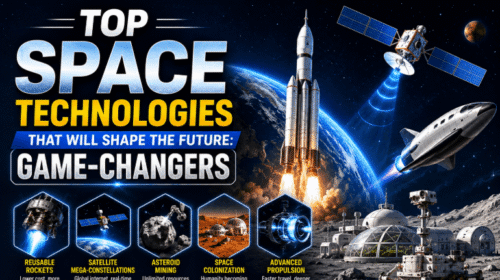
Space technology is changing fast. In recent years, we have seen rockets return to Earth, satellites become smaller, and robots explore planets. But what comes next? Which new technologies will shape the future of space exploration, communication, and even life beyond Earth?
Let’s look at the top space technologies that are driving change—and how they may impact our world in the years ahead.
Getting into space is still expensive and difficult. The most important technology in space travel is the rocket. For decades, rockets were single-use—meaning each launch needed a new rocket. Now, reusable rockets like the SpaceX Falcon 9 have changed the game. These rockets can land back on Earth and fly again, reducing costs by 60% or more.
But the future is not just about reusing rockets. New propulsion systems are being developed. One is ion propulsion. Instead of burning fuel, ion engines use electricity to push ions (tiny charged particles) out the back, moving the spacecraft forward. Ion propulsion is slower but uses much less fuel, making it ideal for deep space travel.
Another promising technology is nuclear propulsion. Unlike traditional rockets, nuclear engines could provide more thrust and work longer. NASA is testing concepts like Nuclear Thermal Propulsion (NTP), which could cut travel time to Mars by half. Faster travel means less risk for astronauts and more efficient missions.
Key data:
Reusable rockets have cut launch costs from $60,000/kg to $2,000/kg.
Ion propulsion has powered missions like NASA’s Dawn spacecraft to visit multiple asteroids.
Nuclear propulsion could reduce Mars trip times from 9 months to about 4–5 months.
Small Satellites And Mega-constellations
Satellites are smaller and smarter than ever. The rise of CubeSats—tiny satellites the size of a shoebox—has made space access easier for universities, startups, and even high school students. These small satellites can perform tasks like Earth observation, climate monitoring, and communication.
A big trend is mega-constellations. Companies like SpaceX and Amazon are launching thousands of satellites to create global internet coverage. The Starlink project has over 5,000 satellites in orbit and plans for up to 12,000.
Advantages:
Lower cost: Small satellites cost less than $100,000 to build and launch.
Faster deployment: A full constellation can be launched in months.
Global reach: Internet coverage for rural and remote areas.
Challenges:
Space debris: More satellites mean more risk of collisions.
Light pollution: Astronomers worry about bright satellites affecting observations.
Type
Size
Cost
Main Use
CubeSat
10x10x10 cm
$50,000–$100,000
Research, Monitoring
Traditional Sat
1–4 m
$200M–$400M
Telecom, TV
Mega-Constellation Sat
~50 cm
$250,000
Internet, GPS
Artificial Intelligence And Autonomous Systems
Artificial Intelligence (AI) is making space exploration smarter and safer. Spacecraft and rovers use AI to make decisions without waiting for commands from Earth. For example, the Mars Perseverance rover uses AI to avoid obstacles and pick the best route.
AI also helps analyze huge amounts of data from telescopes and satellites. Machine learning can spot patterns in images, predict weather, and even find new planets. This speeds up research and helps scientists focus on important discoveries.
Autonomous systems are critical for missions far from Earth. As humans travel to Mars or the Moon, robots with AI can set up habitats, fix equipment, and explore dangerous areas before astronauts arrive.
Non-obvious insight: AI is also used for space traffic management. As more satellites orbit Earth, AI tools track their positions, predict collisions, and send alerts to operators. This is becoming essential as the number of satellites increases.
Space Mining And Resource Utilization
Resources on Earth are limited, but space is full of valuable materials. Space mining aims to extract metals, water, and other resources from asteroids, the Moon, and Mars. These materials can be used for building, fuel, or even life support.
Asteroids contain rare metals like platinum, gold, and rhodium. Some estimates say a single asteroid could be worth billions of dollars. Water found on the Moon or Mars can be split into hydrogen and oxygen for rocket fuel.
In-situ resource utilization (ISRU) means using local materials instead of bringing everything from Earth. ISRU can make space missions cheaper and more sustainable.
Practical example: NASA’s Artemis mission plans to use Moon resources to support human bases. China’s Chang’e 5 brought back lunar soil to study its water content.
Common mistake: Beginners often think space mining is only about getting rich. In reality, its main goal is to support space missions and settlements.
Resource
Location
Potential Use
Water Ice
Moon, Mars
Life Support, Rocket Fuel
Platinum
Asteroids
Electronics, Catalysts
Iron
Asteroids, Moon
Construction
Top Space Technologies That Will Shape the Future 15
Credit: www.ultiplace.com
Space Habitats And Life Support Systems
Living in space is difficult. Humans need air, water, food, and shelter. Modern space habitats focus on making life easier and safer for astronauts.
Life support systems recycle air and water. The International Space Station (ISS) recycles up to 90% of its water. Future habitats will use advanced bioreactors to create oxygen and grow food.
Radiation shielding is another key technology. Space is full of dangerous radiation that can harm humans. New materials and designs, like thick walls and water-based shields, help protect astronauts.
Modular habitats are being developed for the Moon and Mars. These can be expanded as needed and built with local materials. 3D printing is used to make parts and buildings on-site, saving weight and money.
Non-obvious insight: Space habitats may use artificial gravity by spinning. This helps prevent health problems from living in zero gravity for months.
Deep Space Communication
As missions go further, reliable communication becomes harder. Traditional radio signals can take minutes or hours to reach distant spacecraft.
Laser communication is much faster and can carry more data. NASA’s Lunar Laser Communication Demonstration sent data at speeds over 600 megabits per second. This is 10 times faster than radio.
Quantum communication is another future technology. It uses quantum physics to send information in ways that cannot be hacked or intercepted. This may be used for secure communication between Earth and space missions.
Practical example: The Mars Reconnaissance Orbiter sends gigabytes of data from Mars every day, but bandwidth limits slow data transfer. Laser links could help scientists get high-resolution images and videos in real time.
Common mistake: Some people think only astronauts need space communication. In reality, deep space communication is critical for all missions—robots, satellites, and even future colonies.
Top Space Technologies That Will Shape the Future 16
Credit: esi.in
Space Robotics And Human-machine Collaboration
Robots are essential for space exploration. They can go where humans cannot, work in extreme environments, and help build structures.
Robotic arms on the ISS and Mars rovers are famous examples. They perform tasks like repairs, sample collection, and assembly. Humanoid robots like NASA’s Robonaut can work alongside astronauts.
Human-machine collaboration is growing. Astronauts use exoskeletons and wearable tech to boost strength and protect against injury. Robots may also help with medical emergencies, acting as remote surgeons or assistants.
Non-obvious insight: Robots are now being tested for space farming. They plant, monitor, and harvest crops in artificial environments, helping future colonies stay fed.
Space Tourism And Commercial Spaceflight
Space is not just for scientists anymore. Space tourism is becoming real. Companies like Blue Origin, Virgin Galactic, and SpaceX offer flights for private citizens.
Suborbital flights let passengers experience weightlessness for a few minutes. Orbital flights are longer and include stays at private space stations.
Prices are still high—around $250,000 for a suborbital flight—but costs are dropping. More people will be able to visit space in the next decade.
Commercial spaceflight also means more private companies are building rockets, satellites, and habitats. This speeds up innovation and lowers prices.
Company
Service
Price
Duration
Blue Origin
Suborbital Flight
$250,000
10 minutes
SpaceX
Orbital Flight
$55 million
Up to 7 days
Virgin Galactic
Suborbital Flight
$450,000
5–6 minutes
Space-based Solar Power
Earth’s energy needs are growing, but pollution and climate change limit options. Space-based solar power (SBSP) is a way to collect energy from the Sun in space and send it to Earth.
Satellites with large solar panels can collect sunlight 24/7, convert it to energy, and send it down as microwaves or lasers. This means no clouds, no night, and more energy.
Japan and China are testing SBSP prototypes. If successful, SBSP could provide clean energy for millions of homes.
Challenges:
Building and launching huge solar panels is expensive.
Safety concerns about sending energy via microwaves.
Non-obvious insight: SBSP can also power space missions directly, reducing the need for heavy batteries.
Space Medicine And Health Technologies
Health is a major concern in space. Astronauts face problems like muscle loss, bone weakening, and radiation exposure. New technologies are helping keep astronauts safe and healthy.
Telemedicine lets doctors on Earth guide medical procedures in space. Wearable sensors track heart rate, sleep, and stress. Special exercise machines help prevent muscle loss.
Regenerative medicine may allow astronauts to heal faster. Researchers are testing ways to grow tissue and repair damage using stem cells.
Radiation protection is improving with new materials and drugs. NASA is studying medicines that reduce radiation harm.
Non-obvious insight: Space health research is helping people on Earth. For example, bone loss studies in space have led to better treatments for osteoporosis.
Space Law, Ethics, And Governance
As space gets crowded, rules are needed. Space law covers issues like ownership, safety, and pollution.
The Outer Space Treaty (1967) says no country can claim land in space. New laws are needed for space mining, tourism, and mega-constellations.
Space ethics is about doing what’s right. This includes protecting planets from contamination and making sure space is safe for all.
Governance means working together. International groups like the United Nations Committee on the Peaceful Uses of Outer Space (COPUOS) help set standards.
Non-obvious insight: Space law is now focusing on space traffic management and debris removal. As more satellites are launched, preventing collisions is becoming a legal and technical challenge.
Quantum Technologies In Space
Quantum science is changing the way we think about information and security. Quantum sensors can detect tiny changes in gravity, helping map planets and find resources.
Quantum communication is ultra-secure. China’s Micius satellite has tested quantum links between space and Earth, making messages impossible to hack.
Quantum computers in space could analyze huge datasets, like climate or asteroid patterns, much faster than current systems.
Practical example: Quantum sensors may help detect underground water on Mars, making colonization easier.
Common mistake: Beginners often think quantum tech is only for labs. In reality, it’s already being tested in space missions.
Top Space Technologies That Will Shape the Future 17
Credit: www.youtube.com
Space Debris Management
Space is getting crowded. Old satellites, rocket parts, and even paint chips orbit Earth at high speeds. This space debris can damage or destroy working spacecraft.
New technologies aim to remove debris. Robotic arms and nets can capture junk and push it into the atmosphere to burn up. Lasers may be used to nudge debris away from important satellites.
Active debris removal missions are starting. The European Space Agency’s ClearSpace-1 will capture and de-orbit a piece of space junk in 2026.
Data point: Over 30,000 pieces of debris larger than 10 cm are tracked in orbit. Millions of smaller pieces are too tiny to monitor but still dangerous.
Non-obvious insight: Satellites are now designed with de-orbiting systems—like drag sails—that help them fall back to Earth safely after their mission ends.
Exoplanet Exploration And Astrobiology
The search for life beyond Earth is a major goal. Exoplanet exploration uses advanced telescopes and sensors to find planets around other stars.
The James Webb Space Telescope (JWST) can study exoplanet atmospheres, looking for signs of water, oxygen, or even life. Astrobiology uses this data to study how life could exist on other worlds.
Spectroscopy and imaging are key tools. These can spot tiny signals that hint at oceans or plants.
Non-obvious insight: Some exoplanets are found using gravitational lensing—when a planet’s gravity bends light from its star. This is helping scientists find planets far from our solar system.
Practical example: JWST has already found evidence of water vapor on distant exoplanets, a step toward finding habitable worlds.
Space Agriculture And Food Production
Growing food in space is critical for long missions and colonies. Space agriculture uses hydroponics (growing plants in water), LED lighting, and controlled environments.
NASA and ESA are testing ways to grow lettuce, tomatoes, and wheat on the ISS. The goal is to produce fresh food and recycle waste.
Vertical farming and closed-loop systems help use every drop of water and bit of nutrient. These technologies are being adapted for use on the Moon and Mars.
Common mistake: Some people think space food is only freeze-dried meals. In reality, astronauts eat fresh crops and even bake bread in space.
Non-obvious insight: Space farming could help solve food problems on Earth by teaching us to grow more with less.
Frequently Asked Questions
What Is The Most Important Space Technology For The Future?
Many experts believe reusable rockets are the most important because they make space access much cheaper. But technologies like AI, quantum communication, and space mining are also critical for long-term progress.
How Will Space Technologies Affect Daily Life On Earth?
Space technologies improve communication, navigation, weather forecasting, and even health care. Innovations like space-based solar power and AI-driven satellites may help solve energy and climate issues.
Are Space Technologies Safe For The Environment?
Most new technologies aim to reduce pollution and use resources wisely. However, space debris is a growing problem, and efforts are needed to clean up orbit and protect Earth’s atmosphere.
What Role Do Private Companies Play In Space Technology?
Private companies are leading in rockets, satellites, tourism, and habitats. They bring new ideas, speed up innovation, and help lower costs. Examples include SpaceX, Blue Origin, and Virgin Galactic.
Where Can I Learn More About Recent Space Technology Advances?
Check out NASA’s official website for the latest news, missions, and educational resources. They cover everything from rockets to research.
Space technology is not just about exploring the unknown—it’s about improving life on Earth and preparing for a future where humans may live and work across the solar system. With each new breakthrough, we move closer to making space accessible, safe, and useful for everyone.
The next decade will see even more rapid changes, and the world will watch as these top space technologies shape the future.
New Scientific Research That May Change Everyday Life Read More