








Ai in Healthcare 2026: How Artificial Intelligence is Fast-Tracking Drug Discovery
The world of healthcare is changing fast. Artificial intelligence (AI) is at the center of this transformation, especially in the field of drug discovery. In 2026, hospitals, labs, and pharmaceutical companies are turning to AI not only to solve old problems but also to create new opportunities. Finding new medicines used to take years, sometimes decades. With AI, this process is now moving at record speed. What once took 10–15 years can now happen in a fraction of the time. This is not science fiction—it’s real, and it’s happening now.
People around the world need better, safer, and more affordable drugs. The COVID-19 pandemic showed us that quick drug development saves lives. In 2026, the combination of big data, machine learning, and deep learning is making drug discovery smarter. AI is not just a tool; it’s a partner for scientists. It spots patterns in mountains of data, predicts how chemicals might work, and even suggests new drug ideas. This means faster cures, fewer failed trials, and hope for diseases once thought untreatable.
But how exactly is AI changing drug discovery? What breakthroughs are making headlines? And what does the future look like? Let’s explore how AI is revolutionizing healthcare, focusing on the exciting changes shaping 2026 and beyond.
The Traditional Drug Discovery Process: Challenges And Limitations
Understanding the old way of discovering drugs helps us see why AI is such a game changer. For decades, drug discovery was slow, expensive, and risky. Here’s why:
- Time-consuming: The average drug took 10–15 years from early research to pharmacy shelves.
- High failure rate: Over 90% of drugs failed in clinical trials.
- Expensive: Companies spent $1–2 billion for every new medicine that reached the market.
- Limited data analysis: Human researchers could not easily study large datasets or spot hidden patterns.
All these problems meant that patients often waited too long for new treatments. Many potential cures never reached those who needed them.
How Ai Is Transforming Drug Discovery In 2026
AI is not just improving one part of drug discovery—it’s changing the entire process. In 2026, here’s how AI is making a difference:
Faster Target Identification
Before making a drug, scientists must find the right biological target—like a protein or gene linked to a disease. AI tools analyze billions of medical records, genetic data, and scientific papers in hours, not years. This helps scientists quickly spot targets with the highest chance of success.
Smarter Molecule Design
Designing the perfect drug molecule is like finding a needle in a haystack. AI can “imagine” and test thousands of molecules using predictive models. It suggests those most likely to work, saving time and reducing wasted effort.
Speeding Up Preclinical Testing
AI predicts how new drugs might act in the body, including possible side effects or toxic reactions. This means fewer failed lab experiments and animal tests. Drugs that reach human trials are more likely to succeed.
Personalized Medicine
Not all patients are the same. AI helps design drugs for specific groups, or even individuals, based on their genetic makeup. This is making precision medicine a reality in 2026, offering safer and more effective treatments.
Automating Repetitive Tasks
AI-powered robots and software take over boring, repetitive tasks—like scanning chemical libraries or running routine lab tests. This frees up human scientists for creative problem solving.

Credit: www.johnsnowlabs.com
Key Ai Technologies Driving Drug Discovery
AI is a broad field. Several advanced technologies are now crucial for drug discovery:
Machine Learning
Machine learning lets computers learn from data. In drug discovery, it helps predict which molecules will become successful drugs. For example, it can forecast if a compound will bind to a target or cause side effects.
Deep Learning
This is a powerful form of machine learning that uses “neural networks” inspired by the human brain. Deep learning is especially good at analyzing complex data like genetic sequences, medical images, and chemical structures.
Natural Language Processing (nlp)
NLP allows AI to “read” and understand thousands of scientific papers, patents, and clinical trial reports. This helps researchers stay updated and find hidden connections.
Generative Ai
Generative AI doesn’t just analyze data—it creates new ideas. In 2026, these models design brand-new molecules and suggest new ways to target diseases.
Reinforcement Learning
This technology lets AI “learn” by trial and error, much like a human scientist. It’s used to optimize drug candidates and find the best possible solutions.
Case Studies: Ai Success Stories In 2026
Real-life examples show how AI is changing healthcare:
Alphafold And Protein Folding
AlphaFold, created by DeepMind, solved a decades-old problem—predicting how proteins fold. In 2026, this AI tool is standard in labs worldwide. It helps researchers design drugs that fit their targets perfectly, cutting years off the process.
Insilico Medicine’s Ai-discovered Drug
Insilico Medicine developed a drug for pulmonary fibrosis using AI in just 18 months—less than half the usual time. The drug is now in human trials, proving that AI can deliver real results.
Covid-19 Drug Discovery
During the pandemic, AI helped identify promising treatments in weeks. Today, these methods are used for diseases like cancer, Alzheimer’s, and rare genetic conditions.
How Ai Is Shortening Drug Development Timelines
The most exciting change is speed. Here’s a look at how AI is shrinking the drug development timeline:
| Stage | Traditional Timeline | AI-Enabled Timeline (2026) |
|---|---|---|
| Target Identification | 1–3 years | 1–6 months |
| Lead Discovery | 2–4 years | 3–12 months |
| Preclinical Testing | 3–5 years | 1–2 years |
| Clinical Trials | 6–8 years | 3–5 years |
| Total | 10–15 years | 4–7 years |
Key insight: AI is making it possible to develop new drugs in less than half the time it took just a few years ago.
The Role Of Big Data In Ai-powered Drug Discovery
AI needs data to learn. In 2026, the amount of healthcare data is growing fast:
- Electronic health records
- Genetic information from millions of patients
- Medical imaging (X-rays, MRIs)
- Wearable device data (heart rate, sleep patterns)
This big data is a goldmine for AI. The more data AI can analyze, the more accurate and useful its predictions become. For example, AI can spot rare side effects or uncover why a drug works better for some patients.
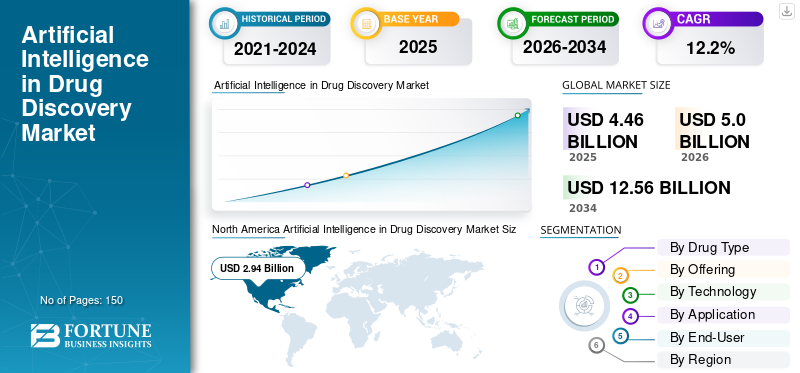
Credit: www.fortunebusinessinsights.com
Comparing Ai-driven And Traditional Drug Discovery
To see the difference, let’s compare the two approaches:
| Aspect | Traditional Discovery | AI-Driven Discovery (2026) |
|---|---|---|
| Data Analysis | Manual, slow | Automated, fast, large-scale |
| Success Rate | ~10% | 20–25% (est.) |
| Cost | $1–2 billion/drug | $500 million–$1 billion/drug |
| Personalization | Limited | High (precision medicine) |
| Innovation Speed | Slow | Rapid |
Non-obvious insight: AI is not just making drug discovery faster—it’s also making it more likely that drugs will succeed and reach patients.
Real-world Examples: Companies Using Ai In Drug Discovery
Many companies are leading the AI revolution in healthcare:
- DeepMind (AlphaFold): Protein folding prediction
- Insilico Medicine: AI-designed drugs in clinical trials
- Exscientia: Automated drug design and testing
- BenevolentAI: AI-driven drug discovery for rare diseases
- Atomwise: Deep learning for chemical compound screening
These organizations show that AI is not just a theory—it’s a practical tool making a difference today.

Credit: www.grandviewresearch.com
Regulatory Changes And Ai In 2026
In the past, regulators were slow to accept AI-designed drugs. By 2026, things have changed. Agencies like the FDA now have special teams to review AI-driven drug submissions. They use AI themselves to check data and predict risks.
A few key changes:
- Faster approvals: AI-generated evidence speeds up review times.
- More collaboration: Companies, regulators, and AI experts work together from the start.
- Better safety monitoring: AI helps track side effects in real time after drugs reach the market.
This cooperation means safe, effective drugs reach patients faster than ever before.
The Impact On Rare And Neglected Diseases
Many diseases are ignored because developing drugs for them is not profitable. AI is changing this by making drug discovery cheaper and faster. In 2026:
- Rare disease drugs are developed using AI models trained on small datasets.
- Neglected tropical diseases get more attention, as AI finds affordable solutions.
- Orphan drugs (for very small patient groups) become possible, thanks to AI’s efficiency.
This is bringing hope to millions who once had no treatment options.
Ai And The Fight Against Antimicrobial Resistance
Antibiotic resistance is a global crisis. Old drugs are failing, and new ones are hard to find. AI is helping:
- Predicting resistance: AI spots bacteria that might resist new drugs.
- Designing novel antibiotics: AI creates molecules never seen before.
- Optimizing combinations: AI finds the best drug pairs to fight tough infections.
By 2026, several AI-designed antibiotics are in clinical trials, offering new hope against “superbugs. ”
Challenges And Risks Of Ai In Drug Discovery
AI is powerful, but not perfect. Some challenges remain:
Data Quality And Bias
AI is only as good as the data it learns from. If the data is biased or incomplete, AI might make wrong predictions. For example, if most data comes from one population, drugs may not work well for everyone.
Transparency
Some AI models are “black boxes”—they make predictions, but humans can’t always see how. This can make it hard to trust the results, especially for regulators and doctors.
Cost And Access
While AI can save money in the long run, building and running AI systems is expensive. Small companies or countries with limited resources may struggle to keep up.
Ethical Concerns
AI raises big questions: Who owns the data? How do we protect patient privacy? Can we trust AI to make life-and-death decisions?
Future Trends: What’s Next For Ai And Drug Discovery?
Looking ahead, a few big trends are set to shape 2026 and beyond:
Ai-driven Clinical Trials
AI is now helping design smarter clinical trials. It can pick the right patients, predict side effects, and even adjust trials in real time based on early results.
Digital Twins
A “digital twin” is a virtual copy of a real patient. AI can use these twins to test drugs and predict outcomes before real people take them. This reduces risk and helps personalize treatment.
Multi-modal Ai Models
In 2026, AI is learning to combine data from many sources—genetics, images, lab results, and even social factors. These “multi-modal” models offer a complete picture of disease and treatment.
Open Science And Collaboration
More companies and universities are sharing data and AI tools. This “open science” approach speeds up progress and ensures discoveries benefit everyone.
Practical Tips For Healthcare Leaders And Researchers
If you work in healthcare or drug development, here’s how to make the most of AI in 2026:
- Invest in data: Good AI needs high-quality, diverse data. Build strong data partnerships.
- Focus on talent: Hire or train people with both medical and AI skills.
- Embrace collaboration: Work with other organizations, regulators, and patient groups.
- Start small: Pilot AI projects before scaling up.
- Stay ethical: Protect patient privacy and explain AI decisions clearly.
Common Mistakes To Avoid
Even in 2026, some organizations struggle with AI adoption. Watch out for these mistakes:
- Ignoring data quality: Poor data leads to poor results.
- Relying only on AI: Human expertise is still essential.
- Underestimating costs: AI projects need investment in technology and talent.
- Failing to update systems: AI models must be retrained as new data comes in.
Ai In Healthcare 2026: Real-world Impact
The changes driven by AI are not just technical—they affect real people. Patients are getting new treatments faster. Doctors have better tools for diagnosis and care. Pharmaceutical companies are more efficient and can focus on tough problems. Even insurance companies are using AI data to set fairer prices.
For example, in 2026, a child with a rare genetic disease in a small town can access a treatment designed by AI, tested on digital twins, and approved in record time. This was unthinkable just a few years ago.
Global Differences And Access
Not every country is moving at the same speed. Wealthy countries like the US, Japan, and Germany are leading in AI-powered drug discovery, but middle-income nations are catching up. Governments and international groups are working to share AI tools and data more widely.
Efforts like the World Health Organization’s open AI projects help spread benefits globally. Still, closing the “AI gap” is a challenge for the next decade.
Key Metrics: Measuring Ai’s Impact
To see if AI is really making a difference, experts track key numbers:
| Metric | 2016 | 2026 (est.) |
|---|---|---|
| Avg. drug development time | 12 years | 5 years |
| Avg. R&D cost per drug | $2 billion | $800 million |
| Success rate | 9% | 22% |
| AI-influenced approvals | 0 | 30+ drugs/year |
These numbers show big progress—and the trend is only accelerating.
Non-obvious Insights For 2026
Here are two things even experts sometimes miss:
- AI is enabling “in silico” trials: Many early drug tests now happen inside computers, not in animals or humans. This reduces costs, speeds up progress, and raises fewer ethical issues.
- AI is helping “rescue” failed drugs: Sometimes, a drug fails for one disease but could work for another. AI can spot these hidden matches, giving old drugs new life.
Expert Predictions: What Will 2030 Look Like?
By 2030, some experts believe:
- Most new drugs will involve AI at every stage.
- “Disease-agnostic” drugs—medicines that work for several conditions—will become common.
- More treatments will be tailored to individual patients, not just large groups.
- AI will help prevent diseases, not just treat them.
These trends suggest that AI’s role in healthcare is just beginning.
A Note On Data Privacy And Security
As AI uses more patient data, privacy is a top concern. In 2026, strong rules like GDPR and HIPAA are in place. Many AI systems use encryption and “federated learning”—training AI on data without moving it from hospitals. This protects privacy and builds trust.
The Bottom Line
AI is not magic, but it is transforming drug discovery at a pace and scale never seen before. In 2026, hospitals, researchers, and companies using AI are leading the way to faster, safer, and more personalized medicines. The journey is not always easy, but the rewards are clear: better treatments, more hope, and healthier lives for millions.
As AI continues to evolve, staying informed and involved is crucial. The future of medicine is being written now—and AI is holding the pen.
Frequently Asked Questions
What Is Ai’s Main Role In Drug Discovery In 2026?
AI helps identify new drug targets, design promising molecules, predict side effects, and speed up the entire process. It can analyze huge amounts of data much faster than humans, making drug discovery faster, cheaper, and more successful.
Are There Any Approved Drugs Developed By Ai?
Yes. By 2026, several drugs developed with the help of AI have reached clinical trials and some have received regulatory approval. For example, drugs for rare diseases and new antibiotics have benefited from AI-driven design and testing.
Does Ai Replace Human Scientists In Drug Discovery?
No. AI is a powerful tool, but human expertise is still essential. Scientists work with AI to ask better questions, interpret results, and make ethical decisions. AI handles data analysis and prediction, while humans bring creativity and judgment.
Is Ai-based Drug Discovery Safe For Patients?
AI speeds up research, but all new drugs still go through strict safety checks and clinical trials. Regulatory agencies use both human experts and AI to review data and monitor side effects. Patient safety remains the top priority.
Where Can I Learn More About Ai In Drug Discovery?
For more information, visit Wikipedia’s Drug Discovery page for up-to-date details and resources on this fast-changing field.
AI Tools vs. Human Effort: Who Wins for Small Business Success?